Non-equiatomic High-Entropy Alloys (HEAs)
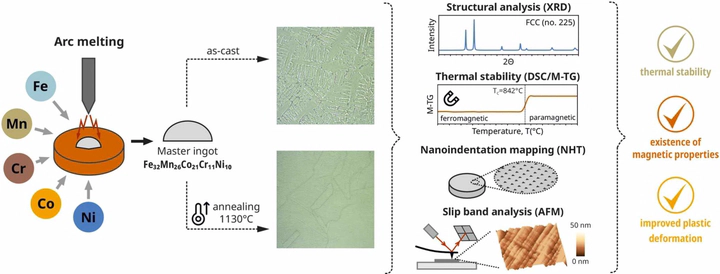
High-entropy alloys (HEAs) represent a paradigm shift in materials design. Instead of relying on a single dominant element, these alloys utilize five or more principal elements in significant proportions to stabilize single-phase solid solutions with exceptional properties. Our laboratory specifically explores the vast “compositional space” of non-equiatomic HEAs, where constituent elements are present in non-equal ratios. This approach offers superior flexibility compared to traditional equiatomic systems, allowing us to precisely tune a material’s functional behavior for extreme conditions.
Research Pillars
- Emergent Ferromagnetism through Engineering: We investigate the transformation of magnetic properties induced by thermal history. In a breakthrough study of the Fe-Mn-Co-Cr-Ni system, we demonstrated a shift from a paramagnetic as-cast state to a ferromagnetic state after annealing, achieving a remarkably high Curie temperature (*TC*) of 842 °C**. This makes these alloys ideal candidates for magnetic sensing and actuation in high-temperature environments where conventional magnets fail.
- Microstructural Evolution and Stability: We study how high configurational entropy promotes the retention of stable structures even at temperatures near the melting point. Our work tracks the transition from dendritic solidification patterns to uniform equiaxed grains with annealing twins, ensuring the material maintains its structural integrity and chemical homogeneity under intense heat.
- Advanced Deformation Mechanisms: Using Atomic Force Microscopy (AFM) and nanoindentation, we analyze the relationship between grain structure and plastic deformation. We focus on the formation of pronounced slip bands, which indicate enhanced dislocation mobility and improved ductility after heat treatment—key factors for developing high-strength structural components.
Related Publications
- Hasiak, M., Łaszcz, A., Biały, M., Kawalec, M., Buczkowska-Fertała, A., Towpik, M. & Komar, M. Effect of annealing on the microstructure and properties of a FeMnCoCrNi non-equiatomic high-entropy alloy. Journal of Alloys and Compounds 1038, 182741 (2025). https://doi.org/10.1016/j.jallcom.2025.182741
- Biały, M., Hasiak, M. & Łaszcz, A. Review on biocompatibility and prospect biomedical applications of novel functional metallic glasses. Journal of Functional Biomaterials 13, 245 (2022). https://doi.org/10.3390/jfb13040245