Magnetic Shape Memory Alloys (MSMAs) & Smart Composites
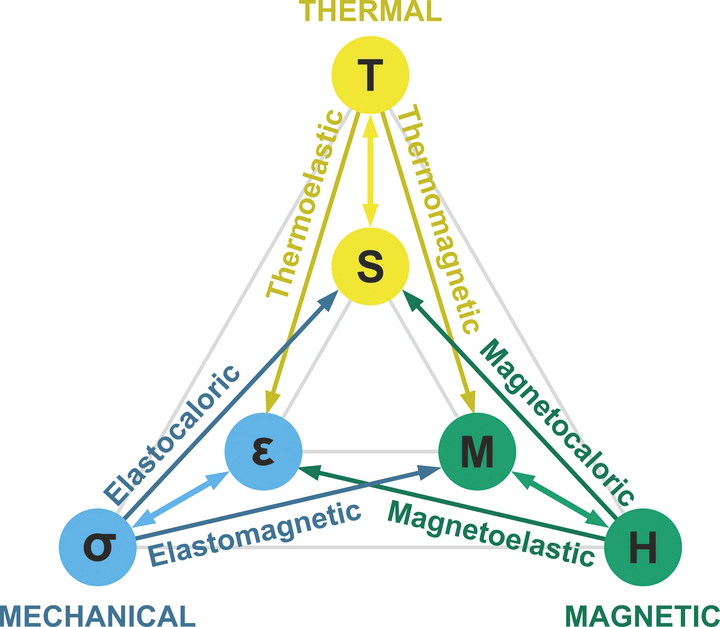
Our laboratory specializes in the development and characterization of Magnetic Shape Memory Alloys (MSMAs), a cutting-edge class of multifunctional smart materials. These materials, primarily Heusler-type alloys such as Ni-Mn-Ga , are defined by their ability to undergo a reversible martensitic transformation—a structural shift between a high-symmetry austenite phase and a low-symmetry martensite phase. This unique mechanism allows them to exhibit magnetic field-induced strains (MFIS) significantly higher than those of traditional piezoelectric or magnetostrictive materials.
Research Objectives
- Tuning Transformation Temperatures via Doping: The functional properties of MSMAs are highly sensitive to their chemical composition. We investigate the effects of Ti and Gd substitution for Gallium to strategically shift transformation temperatures. For instance, our studies have shown that Gd-doping can increase the martensitic transition temperature to the room temperature regime, which is critical for practical engineering use.
- Magnetocrystalline Anisotropy & Smart Control: A central part of our work is analyzing magnetocrystalline anisotropy, particularly in the martensitic phase where it is significantly higher than in austenite. Understanding this anisotropy is essential for controlling twin variant reorientation, the process responsible for the shape memory effect. We use the law of approach to magnetic saturation to precisely estimate these anisotropy constants across wide temperature ranges.
- Advanced Applications in Sensors and Actuators: By optimizing the coupling between magnetic and mechanical properties, we develop materials for next-generation smart systems. These include high-performance actuators, sensors, smart damping systems, and vibration energy harvesters. Our research also extends to the magnetocaloric effect within these alloys, exploring their potential for environmentally friendly solid-state cooling.
Related Publications
- Łaszcz, A., Hasiak, M. & Kaleta, J. Temperature Dependence of Anisotropy in Ti and Gd Doped NiMnGa-Based Multifunctional Ferromagnetic Shape Memory Alloys. Materials 13, 2906 (2020). https://doi.org/10.3390/ma13132906
- Łaszcz, A., Hasiak, M. & Kaleta, J. Effects of Ti and Gd for Ga substitution on microstructure, magnetic and mechanical properties of polycrystalline Ni-Mn-Ga magnetic shape memory alloy. Journal of Magnetism and Magnetic Materials 476, 497–505 (2019). https://doi.org/10.1016/j.jmmm.2019.01.031
- Łaszcz, A., Hasiak, M. & Kaleta, J. Microstructure, magnetism and nanomechanical properties of Ni50Mn25Ga20Gd5 magnetic shape memory alloy before and after heat treatment. Journal of Rare Earths 37, 1224–1229 (2019). https://doi.org/10.1016/j.jre.2019.01.004
- Łaszcz, A., Hasiak, M. & Kaleta, J. Structural, Magnetic and Mechanical Properties of Dual-Phase Ni50Mn25Ga20Gd5 magnetic shape memory alloy. Acta Physica Polonica A 135, 301–304 (2019). https://doi.org/10.12693/APhysPolA.135.301
- Żak, A., Łaszcz, A., Hasiak, M., Gerstein, G., Maier, H. J. & Dudzinski, W. Ion polishing as a method of imaging the magnetic structures in CoNiGa monocrystal. Results in Physics 10, 277–280 (2018). https://doi.org/10.1016/j.rinp.2018.06.020